


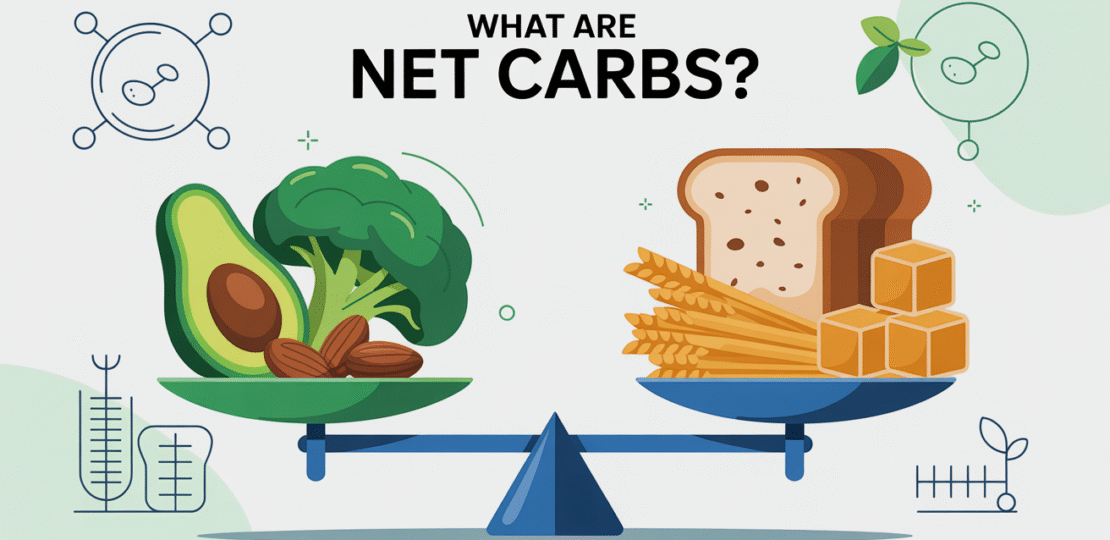
If you’re starting a keto or low-carb diet, you’ve probably heard the term “net carbs” thrown around. But what exactly are net carbs, and why do they matter more than total carbs? This beginner-friendly guide breaks down everything you need to know in simple terms.
Quick Answer: What Are Net Carbs?
Net carbs are the carbohydrates in food that your body can actually digest and use for energy. They’re calculated by subtracting fiber and certain sugar alcohols from total carbohydrates because these components don’t significantly impact your blood sugar levels.
The basic formula is:
Net Carbs = Total Carbohydrates − Dietary FiberFor example, if a food has 20g of total carbs and 8g of fiber, it contains 12g of net carbs.
Want to check net carbs in any food instantly? Use our free CheckTheCarbs tool with data from the USDA database.
Why Net Carbs Matter More Than Total Carbs
When you eat carbohydrates, your body breaks them down into glucose (sugar), which enters your bloodstream and raises your blood sugar levels. However, not all carbohydrates affect your blood sugar the same way.
The Science Behind Net Carbs
Your digestive system lacks the enzymes needed to break down dietary fiber. According to the Joslin Diabetes Center, “Fiber does not raise glucose levels because it is not digested by the body.”1 This means fiber passes through your system without being converted to glucose.
Research published in Diabetes Care confirms that “there is no significant effect of dietary fiber, per se, on fasting blood glucose” because it’s not digested and absorbed.2
This is why we subtract fiber from total carbs – it simply doesn’t impact your blood sugar the way digestible carbohydrates do.
Real-World Example
Let’s compare two foods with the same total carbs:
Food A: White Bread (1 slice)
- Total Carbs: 15g
- Fiber: 1g
- Net Carbs: 14g
Food B: Avocado (100g)
- Total Carbs: 12g
- Fiber: 10g
- Net Carbs: 2g
Even though the avocado has nearly the same total carbs as the bread, it has 7 times fewer net carbs. This means the avocado will have a much smaller impact on your blood sugar.
How to Calculate Net Carbs (Step-by-Step)
Basic Calculation (Whole Foods)
For most whole foods like fruits, vegetables, and meats, the calculation is simple:
- Step 1: Find “Total Carbohydrates” on the nutrition label
- Step 2: Find “Dietary Fiber” (listed under Total Carbohydrates)
- Step 3: Subtract fiber from total carbs
Example: 1 Cup of Broccoli
- Total Carbohydrates: 11g
- Dietary Fiber: 5g
- Net Carbs: 11g − 5g = 6g
Advanced Calculation (Packaged Foods)
Some packaged foods contain sugar alcohols, which also need to be subtracted (partially or fully, depending on the type):
Net Carbs = Total Carbs − Fiber − Sugar AlcoholsExample: Keto Protein Bar
- Total Carbohydrates: 20g
- Dietary Fiber: 10g
- Erythritol (sugar alcohol): 8g
- Net Carbs: 20g − 10g − 8g = 2g
Important: Not all sugar alcohols can be fully subtracted. **Erythritol** and **allulose** can be subtracted 100%, but **maltitol** should only be partially subtracted. Learn more about sugar alcohols →
Net Carbs vs Total Carbs: Key Differences
| Aspect | Total Carbs | Net Carbs |
|---|---|---|
| Definition | All carbohydrates in food | Only digestible carbohydrates |
| Includes | Sugars, starches, fiber, sugar alcohols | Only sugars and starches |
| Blood Sugar Impact | Misleading (includes non-digestible carbs) | Accurate (only digestible carbs) |
| Used By | FDA nutrition labels | Keto, Atkins, low-carb diets |
| Example (Avocado) | 12g | 2g |
Why this matters: If you only tracked total carbs, you’d think an avocado has 12g of carbs. But since 10g is fiber, your body only processes 2g – a huge difference if you’re trying to stay in ketosis or manage blood sugar.
Who Should Track Net Carbs?
People Following These Diets:
- Ketogenic (Keto) Diet
- Goal: Stay under 20-50g net carbs per day
- Purpose: Enter and maintain ketosis (fat-burning state)
- Net carbs are essential for tracking
- Low-Carb Diet
- Goal: Stay under 50-150g net carbs per day
- Purpose: Weight loss, blood sugar control
- Net carbs provide more flexibility
- Atkins Diet
- Goal: Varies by phase (20-100g net carbs)
- Purpose: Structured low-carb approach
- Invented the concept of net carbs
- Diabetes Management
- Goal: Control blood sugar levels
- Purpose: Prevent glucose spikes
- Net carbs = more accurate carb counting
People Who Benefit Most:
- ✅ Type 2 diabetics – Better blood sugar control
- ✅ Pre-diabetics – Prevent progression to diabetes
- ✅ Weight loss seekers – More food flexibility
- ✅ Athletes – Optimize performance on low-carb
- ✅ Anyone managing insulin resistance
Common Questions About Net Carbs
Does the FDA Recognize Net Carbs?
No, the FDA does not officially recognize “net carbs” on nutrition labels. The FDA requires all carbohydrates to be listed as “Total Carbohydrates.”3
However, the concept is scientifically sound and widely used by the low-carb community, dietitians, and medical professionals. The calculation is based on established research about carbohydrate digestion and metabolism.
Are Net Carbs Accurate?
Yes, for most people, net carbs provide a more accurate picture of how food affects blood sugar than total carbs. However, individual responses can vary.
Research shows that dietary fiber intake above 25g per day is associated with a 20-30% reduced risk of developing type 2 diabetes,4 supporting the idea that fiber doesn’t contribute to blood sugar problems the way digestible carbs do.
Important note: Some people with diabetes may still need to count total carbs or monitor their individual response to high-fiber foods.
Can I Eat Unlimited Net Carbs?
No. While net carbs are more accurate than total carbs, you still need to stay within your daily limit based on your diet and goals:
- Keto diet: 20-50g net carbs per day
- Low-carb diet: 50-150g net carbs per day
- Moderate carb: 150-200g net carbs per day
Do All Fibers Count the Same?
Yes, for net carb calculation purposes, all dietary fiber is subtracted equally. The FDA defines dietary fiber as non-digestible carbohydrates, and research shows it doesn’t raise blood glucose levels.1
However, different types of fiber have different health benefits:
- Soluble fiber (oats, beans) – Helps lower cholesterol
- Insoluble fiber (vegetables, whole grains) – Promotes digestive health
What About Sugar-Free Foods?
Be careful with sugar-free foods. Many contain sugar alcohols, which can be tricky:
- ✅ Can subtract 100%: Erythritol, allulose
- ⚠ Subtract 50%: Xylitol, sorbitol
- ❌ Subtract 25%: Maltitol (still impacts blood sugar)
Always check which sugar alcohol is used. Complete sugar alcohol guide →
Net Carbs in Common Foods
Here’s a quick reference for net carbs in popular foods:
Very Low Net Carbs (0-5g per 100g) ✅ Keto-Friendly
| Food | Total Carbs | Fiber | Net Carbs |
|---|---|---|---|
| Avocado | 12g |
RELATED POSTS
View all


Net Carbs vs Total Carbs: The Ultimate Scientific Comparison (2025 Guide)
October 22, 2025 | by robbeaux